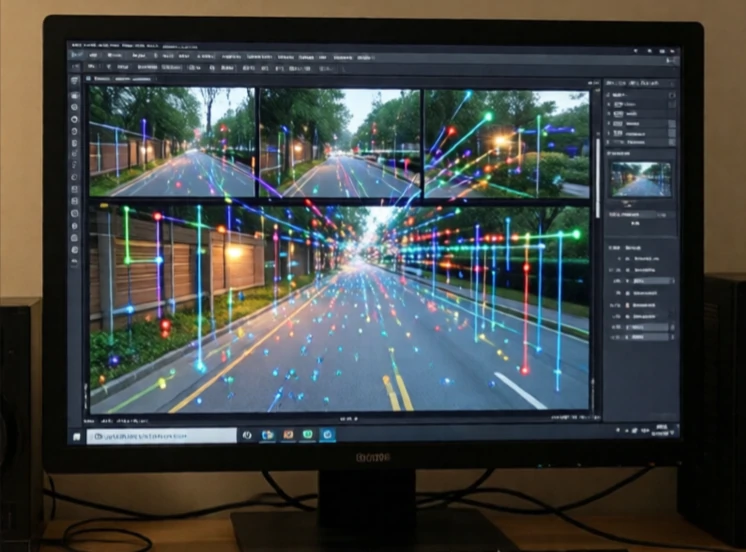
Odometry estimates a robot's position by tracking its motion. Wheel encoders count rotations. IMU measures acceleration and rotation. By integrating these measurements over time, the robot estimates how far it has moved and in what direction. Odometry is relative. It starts from a known position and dead-reckons from there.
The problem is drift. Small errors accumulate. A wheel that slips, a slightly miscalibrated encoder, a bumpy floor: all add up. After a few minutes, a robot relying only on odometry can be meters off. That is why odometry is almost always fused with other sensors. GPS corrects outdoor drift. Lidar and cameras correct indoor drift by recognizing landmarks.
Odometry sources
- Wheel encoders: count rotations, estimate distance.
- Visual odometry: track features across camera frames.
- Lidar odometry: match scan patterns between frames.
- IMU: measure acceleration and rotation.
- Optical flow: track ground texture for speed.
Visual odometry is popular because cameras are cheap and information-rich. A drone can estimate its motion by tracking features on the ground. A car can estimate its motion by tracking lane lines and signs. Lidar odometry is more accurate but more expensive. The best systems combine multiple sources. Wheel odometry works well on smooth floors but fails on ice. Visual odometry works in textured environments but fails in fog. IMU works everywhere but drifts fast. Fusing them gives a robust estimate. Odometry is not a replacement for localization. It is the short-term memory that bridges the gaps between absolute position fixes.
Comments
No comments yet. Be the first to share a thought.
Leave a comment