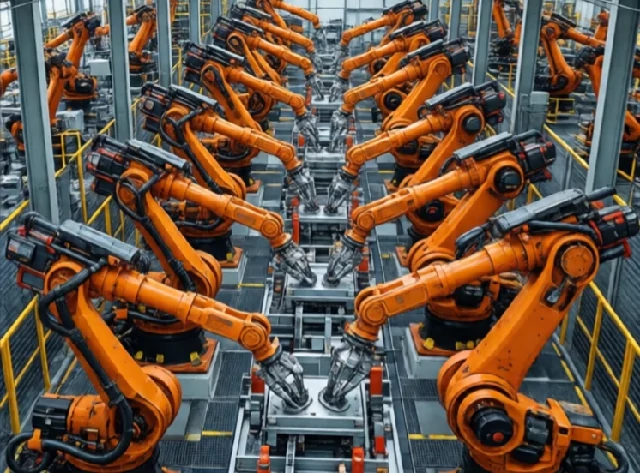
An industrial robot is a programmable machine used in manufacturing. It welds car frames, paints panels, moves pallets, and assembles electronics. The first one, Unimate, started work at a General Motors plant in 1961, lifting hot metal parts from a die-casting machine. It did not complain about the heat.
Most industrial robots are arms bolted to a floor or ceiling. They repeat a taught path millions of times with sub-millimeter precision. Safety fences keep people away because the robots move fast and do not see. Newer models add vision and force sensing, which lets them adapt to slight variations in parts.
Common industrial robot types
- Articulated arm: six axes, flexible, the most common type.
- SCARA: four axes, fast, used for assembly and pick-and-place.
- Delta: parallel links, extremely fast, used in food packaging.
- Cartesian: linear axes, simple, used for 3D printing and CNC tending.
The economics are simple. A robot costs money upfront but works three shifts without breaks. It pays back in one to three years on high-volume lines. Small shops often cannot justify the cost, which is why collaborative robots are gaining ground. The industrial robot is not intelligent in a human sense. It is precise, tireless, and strong, and that is enough for most factory work.
Comments
No comments yet. Be the first to share a thought.
Leave a comment