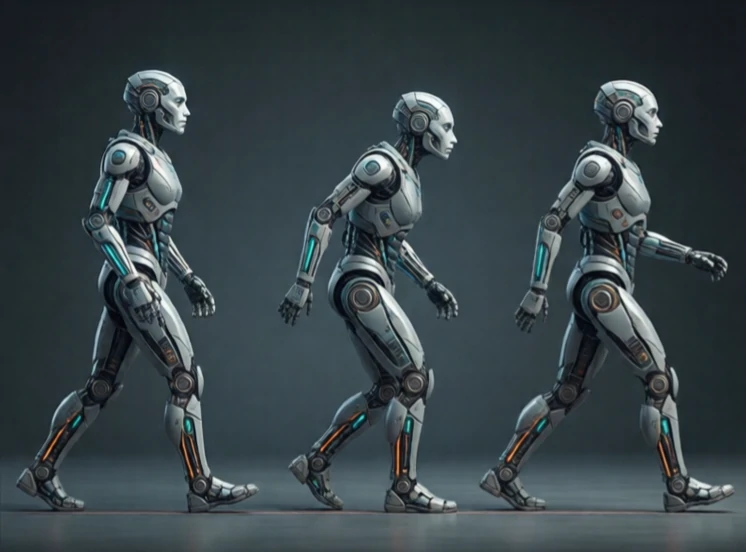
Gait is the pattern of movement of a legged robot. It describes how the legs step, how long each foot stays on the ground, and how the body shifts to maintain balance. Walking, trotting, running, and hopping are all gaits.
Animals use different gaits at different speeds. A horse walks, trots, canters, and gallops. Legged robots do the same. Boston Dynamics' Spot uses a trot at moderate speed. The MIT Cheetah transitions from trot to bound to gallop. Each gait has a different duty factor, the fraction of time a foot is on the ground.
Common robot gaits
- Walk: one foot at a time, stable, slow.
- Trot: diagonal pairs, faster, moderate stability.
- Bound: front legs together, back legs together.
- Gallop: asymmetric, fast, dynamic.
- Hop: both legs together, used by some hopping robots.
Choosing a gait is a trade-off between speed, stability, and energy efficiency. Walking is stable but slow. Running is fast but risks falling. A robot that needs to carry a heavy payload might use a walk. One that needs to cover ground quickly might use a trot. The controller must also handle transitions between gaits. A horse does not think about switching from trot to gallop. A robot must plan it, adjusting leg timing and body posture smoothly. Gait is where mechanics, control, and biology meet.
Comments
No comments yet. Be the first to share a thought.
Leave a comment