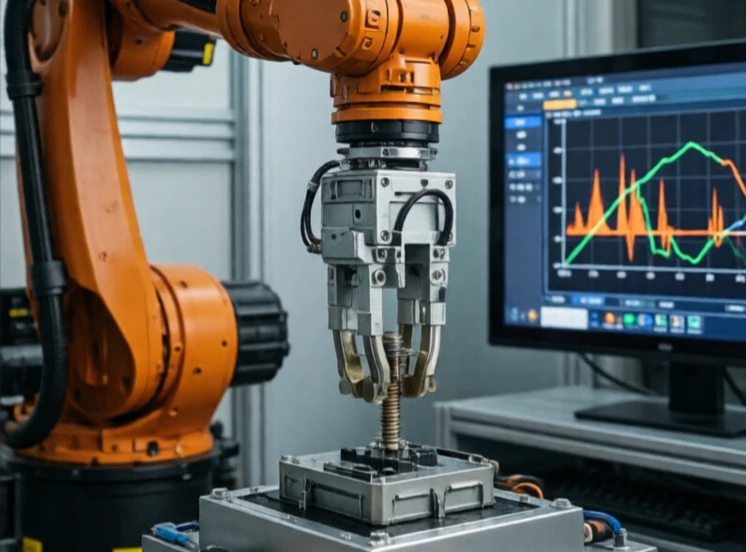
Force control regulates how hard a robot pushes or pulls. Position control says go here. Force control says push with this much force. The difference matters when the robot interacts with something that can break or deform.
Grinding, polishing, deburring, and assembly all require force control. A robot polishing a curved surface must maintain constant pressure even as the surface moves. A robot inserting a connector must push hard enough to seat it but not so hard it breaks. Force sensors at the wrist measure the contact force and feed it back to the controller.
Force control approaches
- Direct force control: maintain a target force.
- Impedance control: regulate the relationship between force and motion.
- Hybrid control: position control in some directions, force control in others.
- Sensorless force estimation: infer force from motor current.
- Compliant mechanisms: passive springs absorb excess force.
Force control is harder than position control because contact is nonlinear. The moment the tool touches the surface, the dynamics change. The controller must switch modes smoothly. It also needs a force sensor with low noise and high bandwidth. Without good force control, robots cannot do tasks that humans do with ease: wiping a window, tightening a bolt, or fitting two parts together. As robots move out of cages and into human spaces, force control becomes essential. It is the difference between a robot that crashes into things and one that touches them gently.
Comments (2)
Leave a comment