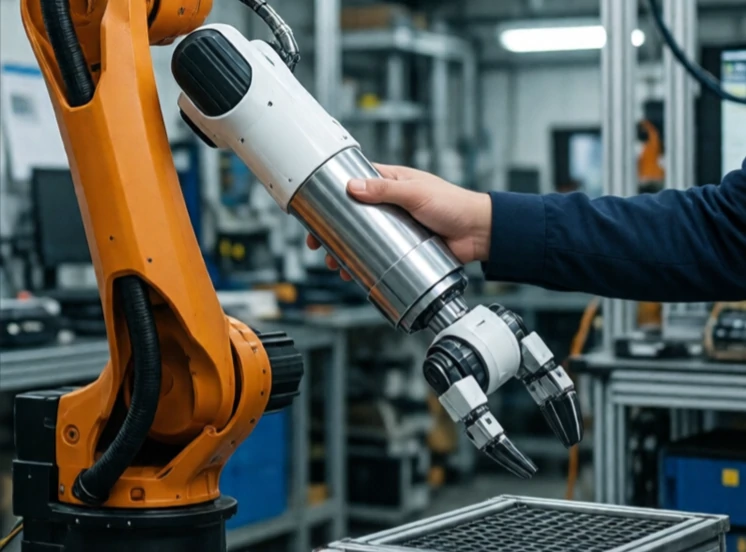
Compliance control lets a robot yield to external forces. Instead of holding a rigid position, the robot behaves like a spring or damper. Push it and it moves. Let go and it returns. That flexibility makes robots safer and more capable in unstructured environments.
Traditional industrial robots are stiff. They hold position no matter what. That is useful for milling metal but dangerous around people and clumsy for tasks like inserting a peg into a hole. Compliance control softens the response. It can be passive, using springs or flexible materials, or active, using force sensors and software to simulate spring behavior.
Types of compliance
- Passive compliance: mechanical springs or flexible joints.
- Active compliance: force sensors and control algorithms.
- Impedance control: regulates force-motion relationship.
- Admittance control: measures force and commands motion.
- Variable stiffness: changes compliance based on task.
Compliance is essential for assembly. A rigid robot trying to insert a peg into a hole will jam or break something. A compliant robot wiggles the peg until it slips in, like a person does. Compliance also makes human-robot collaboration safer. A stiff robot arm that hits a person can cause injury. A compliant arm gives way. The trade-off is precision. Too much compliance and the robot cannot hold a position accurately. The art is tuning the stiffness for the task, stiff where precision matters, soft where safety and adaptability matter more.
Comments (2)
Leave a comment