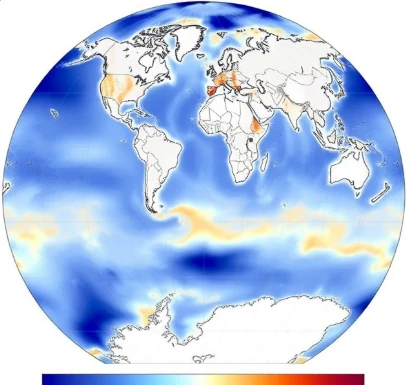
The total concentration of dissolved salts in seawater is its salinity. Average open-ocean salinity is about 35 grams of salt per kilogram of seawater, but the value varies regionally from the low-salinity polar and coastal waters to the high-salinity subtropical gyres where evaporation exceeds precipitation.
Salinity, together with temperature, controls seawater density and therefore the circulation of the ocean. It is measured most accurately through electrical conductivity, with results reported on the Practical Salinity Scale. Absolute salinity, which accounts for regional composition differences, is used for the most precise density calculations.
Salinity patterns reveal the history of water masses—where they were precipitated or evaporated, where ice formed or melted, and how they mixed. The global salinity distribution is now mapped continuously by satellites and the Argo array, providing a sensitive indicator of the intensifying hydrological cycle under climate change.
A difference of one salinity unit is enough to create a distinct, long-lived water mass.
Comments
No comments yet. Be the first to share a thought.
Leave a comment