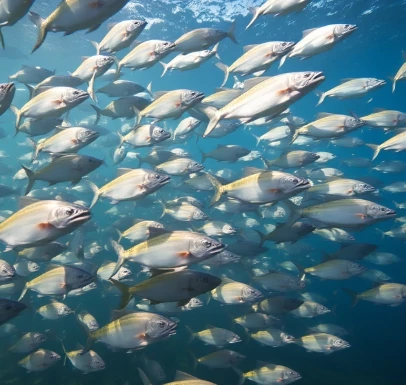
Organisms that can swim strongly enough to move independently of currents are classified as nekton. The category includes most adult fish, squid, marine mammals, and some larger crustaceans and reptiles. In contrast, plankton drift with the water, and benthos live on or in the seafloor.
Nektonic animals occupy every depth zone from the surface to the deep sea. Their ability to navigate allows them to migrate, pursue prey, escape predators, and select favorable habitats. Many species undertake daily vertical migrations or seasonal journeys spanning thousands of kilometers.
Fisheries target nekton almost exclusively. Understanding their behavior, physiology, and population dynamics is therefore central to resource management. Acoustic surveys, tagging, and genetic methods help track movements and estimate abundance. Changes in temperature, oxygen, and prey distribution are already shifting the ranges of many nektonic species.
A tuna swimming against a current exemplifies the independence that defines nekton.
Comments
No comments yet. Be the first to share a thought.
Leave a comment