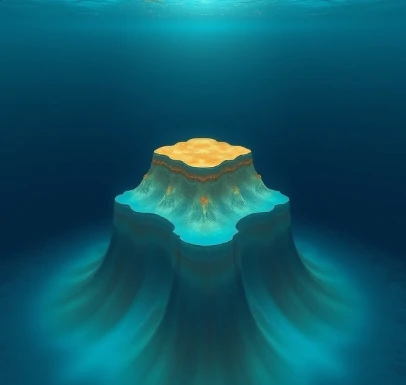
Some underwater mountains have broad, flat tops instead of pointed peaks. These are guyots, or tablemounts. Most formed as volcanic islands that were later eroded by waves to sea level and then subsided beneath the surface as the underlying tectonic plate cooled and sank.
Guyots are common in the Pacific, where chains of volcanic seamounts record the passage of the plate over hotspots. Their flat summits may still retain coral-reef deposits from the time they were at the surface, providing archives of past sea level and climate. Depths to the summit plateau typically range from several hundred to a few thousand meters.
The slopes of guyots can host diverse benthic communities, and the summits sometimes support dense populations of filter feeders that take advantage of accelerated currents. Because they rise high above the surrounding abyssal plain, guyots are conspicuous targets for both scientific sampling and, more controversially, deep-sea mining exploration.
A single guyot can preserve a geological history spanning tens of millions of years on its summit and flanks.
Comments
No comments yet. Be the first to share a thought.
Leave a comment