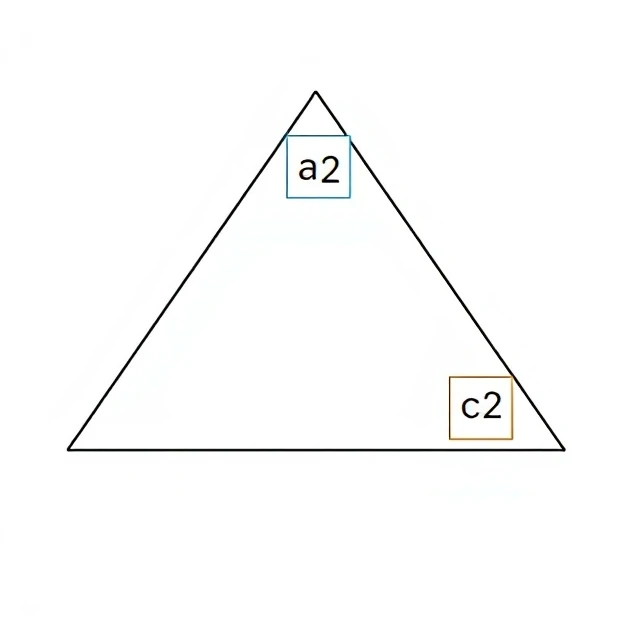
In any right triangle, the square of the hypotenuse equals the sum of the squares of the other two sides. If the legs are a and b and the hypotenuse is c, then a² + b² = c². For a 3-4-5 triangle, 9 + 16 = 25.
The theorem is named after Pythagoras, though Babylonian tablets show knowledge of the relationship over a thousand years earlier. Euclid provided a proof in his Elements. Hundreds of proofs exist, including one by a U.S. president, James Garfield.
The theorem is used to find distances, verify right angles, and solve problems in navigation, construction, and computer graphics. The distance formula in coordinate geometry is a direct application. It is one of the most famous and widely used results in all of mathematics.
- a² + b² = c² for right triangles
- Named after Pythagoras but known earlier
- Hundreds of proofs exist
- Used in distance, construction, and graphics
Comments
No comments yet. Be the first to share a thought.
Leave a comment