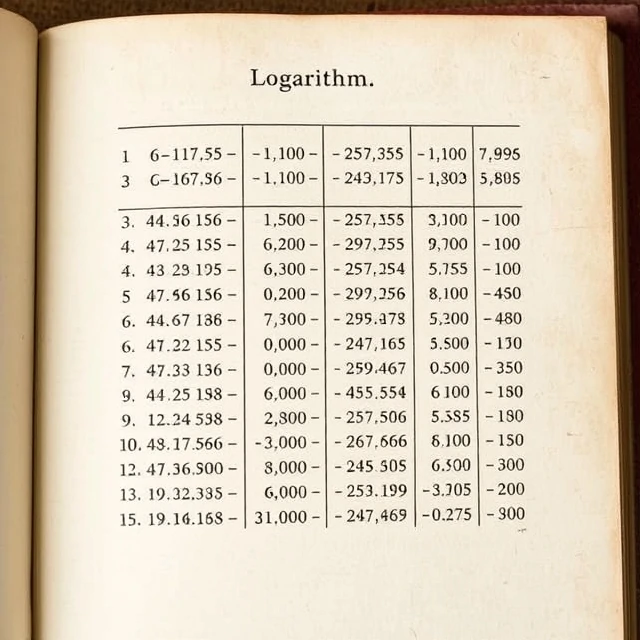
A logarithm answers the question: what exponent do I need? If 10³ = 1000, then the base-10 logarithm of 1000 is 3. Written log₁₀(1000) = 3. Logarithms undo exponentiation the way subtraction undoes addition.
Logarithms were invented by John Napier in the early seventeenth century to simplify multiplication and division. By converting products to sums, they saved astronomers and navigators countless hours. Slide rules, based on logarithms, were standard tools until electronic calculators appeared.
Natural logarithms use base e and appear throughout calculus and physics. Logarithmic scales measure sound (decibels), earthquake intensity (Richter), and acidity (pH). The function grows slowly, making it useful for compressing large ranges. Logarithmic and exponential functions are inverses, a relationship central to many fields.
- Exponent needed to produce a number
- Inverse of exponentiation
- Invented by Napier for calculation
- Used in decibels, Richter scale, and pH
Comments
No comments yet. Be the first to share a thought.
Leave a comment