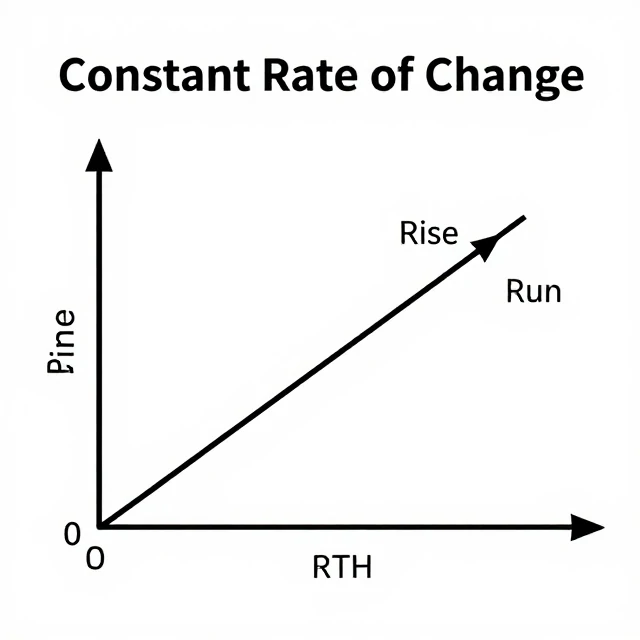
A constant rate of change means a quantity changes by the same amount over equal intervals. It is the signature of a linear function. A car traveling at a steady 60 miles per hour has a constant rate of change. Every hour, the distance increases by 60 miles. The graph is a straight line. The slope is the rate of change.
The slope is rise over run. For a linear function, the slope is the same everywhere. Pick any two points on the line. The change in y divided by the change in x is the same. That is what makes it constant. A nonlinear function has a changing slope. A curve gets steeper or shallower. A line does not.
Constant rate of change in context
- Speed: distance per unit time.
- Unit price: cost per item.
- Hourly wage: dollars per hour.
- Density: mass per unit volume.
- Gradient: vertical change per horizontal distance.
The constant rate of change is the slope of a line. It tells you how fast y changes when x changes. A positive slope means y increases as x increases. A negative slope means y decreases. A zero slope means y is constant. The steeper the slope, the faster the change. Linear functions are simple because the rate is constant. Real-world relationships are often nonlinear. Population growth, radioactive decay, and compound interest are not linear. But linear models are useful approximations over short intervals. And the concept of a constant rate of change is the foundation for understanding calculus. The derivative is the instantaneous rate of change. For a line, the derivative is constant. For a curve, it varies. That is the difference between linear and nonlinear.
Comments
No comments yet. Be the first to share a thought.
Leave a comment