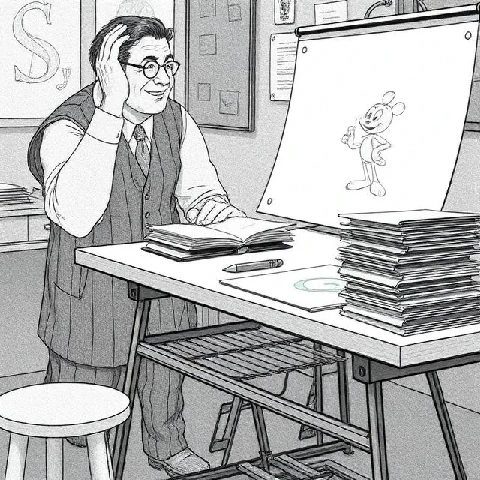
An animated film does not record motion. It creates it. Animation displays a sequence of still images in rapid succession, relying on the persistence of vision to make them appear to move. A flipbook does this with paper and thumb. A feature film does it with tens of thousands of drawings, or with digital models that a computer renders frame by frame. The technique is old. The illusion still works.
There are several forms. Traditional cell animation draws each frame by hand, as Disney did for Snow White. Stop-motion animates physical objects, moving them slightly between exposures, as Aardman does with Wallace and Gromit. Rotoscoping traces live-action footage, frame by frame. Computer animation builds characters and environments in 3D software, then calculates each frame, as Pixar does. Each method has its own craft and its own look.
Animation is not a genre. It is a medium. It tells horror stories, documentaries, adult dramas, and children's tales. It can be photorealistic or abstract. It can be expensive or cheap. Hayao Miyazaki's hand-drawn worlds sit alongside the procedural crowds of Pixar's software. The form is flexible. The best animation uses movement to express something that live action cannot.
Comments
No comments yet. Be the first to share a thought.
Leave a comment