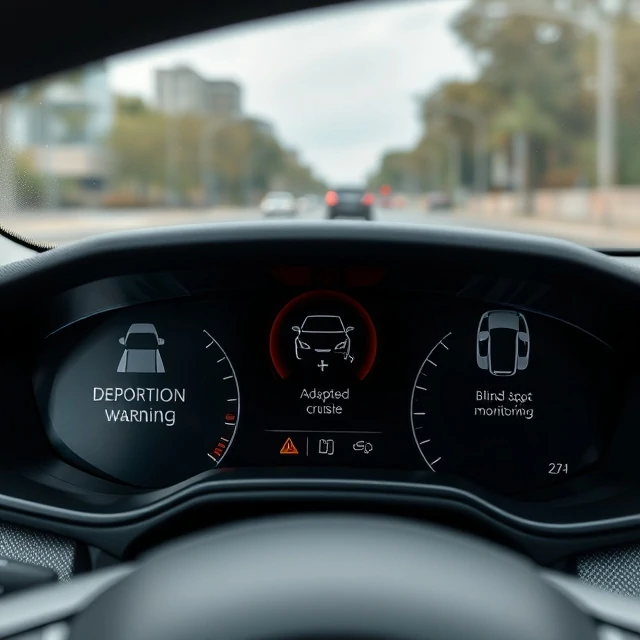
Modern cars watch the road even when the driver does not. Advanced Driver Assistance Systems, or ADAS, use cameras, radar, lidar, and ultrasonic sensors to monitor the vehicle's surroundings. They warn of impending collisions, keep the car in its lane, maintain a safe following distance, and in some cases apply the brakes or steer automatically.
The building blocks are familiar. Adaptive cruise control adjusts speed to match the car ahead. Lane departure warning vibrates the seat or sounds a chime when you drift. Blind spot monitoring lights up a warning in the mirror. Automatic emergency braking intervenes when a crash is imminent. Each system works independently, but they often share sensors and data.
ADAS is not self-driving. Most systems require the driver to stay engaged and ready to take over. The Society of Automotive Engineers classifies autonomy on a scale from 0 to 5. Most ADAS features sit at Level 1 or 2, where the driver remains responsible. Tesla's Autopilot, GM's Super Cruise, and Ford's BlueCruise are Level 2 systems with varying capabilities.
The technology saves lives. Studies by the Insurance Institute for Highway Safety show that automatic emergency braking reduces rear-end crashes by roughly half. But it also introduces new problems. Drivers may over-trust the system. Sensors can be blinded by rain, snow, or dirt. Repair costs climb when a windshield-mounted camera needs recalibration.
Comments
No comments yet. Be the first to share a thought.
Leave a comment