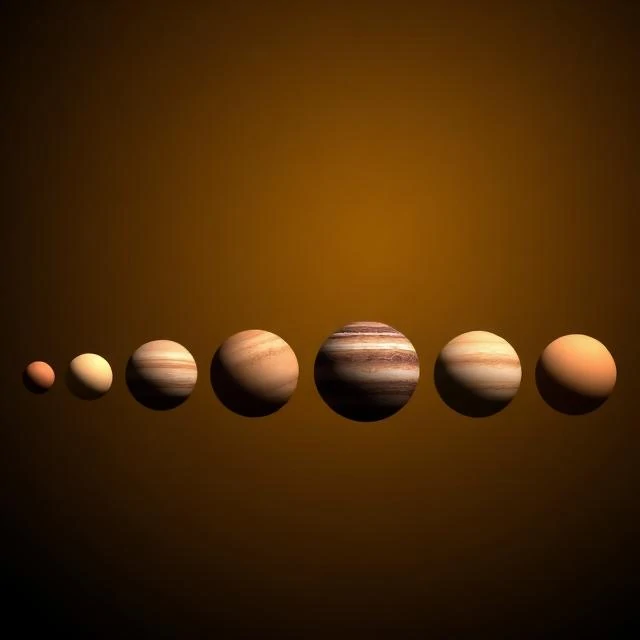
In 2006, the International Astronomical Union defined a planet as a celestial body that orbits the Sun, is massive enough for its own gravity to make it round, and has cleared its orbital neighborhood of other objects. That last criterion is what demoted Pluto. It also means that objects orbiting other stars, called exoplanets, are defined by a slightly different set of rules.
The solar system has eight planets. Four are rocky: Mercury, Venus, Earth, and Mars. Two are gas giants: Jupiter and Saturn. Two are ice giants: Uranus and Neptune. They range from Mercury's scorched surface to Jupiter's stormy bands, from Venus's runaway greenhouse to Neptune's supersonic winds. Each is a world with its own history.
Planets form from the disk of gas and dust around a young star. Dust grains stick together, forming planetesimals, which collide and grow into protoplanets. Some become large enough to capture gas from the disk, becoming giants. Others remain rocky. The process is messy, with collisions, migrations, and ejections shaping the final architecture.
Thousands of exoplanets are now known. They include hot Jupiters, super-Earths, and planets orbiting two stars. The diversity is far greater than anyone expected. The definition of planet may need to evolve again.
Comments
No comments yet. Be the first to share a thought.
Leave a comment