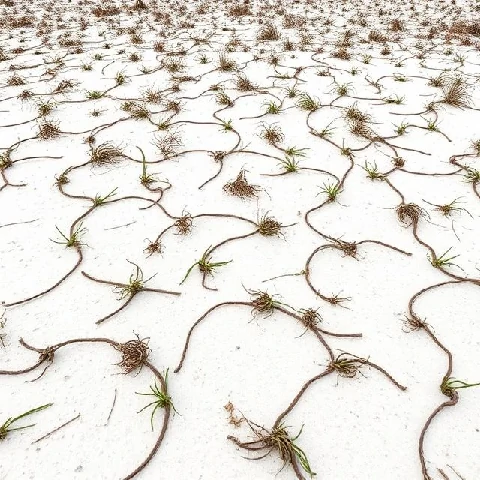
Salinization is the buildup of soluble salts in soil to levels that harm crops. It happens naturally in dry regions where evaporation exceeds rainfall, but irrigation makes it worse. When irrigation water evaporates or is taken up by plants, the salts it carried stay behind. Over years or decades, they accumulate in the root zone.
The problem is enormous. An estimated 20 percent of irrigated land worldwide is affected, with hotspots in Pakistan, India, China, Central Asia, and the Middle East. The Aral Sea crisis is partly a salinization story: cotton irrigation in the Amu Darya and Syr Darya basins left salt-crusted fields behind. Salinity also affects coastal farmland when seawater intrudes into aquifers.
Signs and fixes
- White crust on the soil surface
- Stunted crops with yellowing, scorched leaf edges
- Bare patches where nothing germinates
- Poor drainage and a rising water table
Reclamation requires flushing salts below the root zone with excess water and installing drainage to carry them away. That takes water, which is scarce in the regions where salinization is worst. Growing salt-tolerant crops like barley or date palms is a partial alternative.
Comments
No comments yet. Be the first to share a thought.
Leave a comment