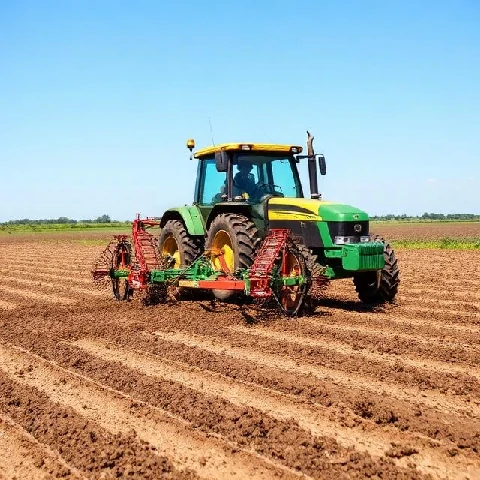
The plow is one of the oldest farm tools still in use. Its job is simple: cut into the soil, lift it, and turn it over. That buries weeds and crop residue, loosens compacted ground, and prepares a seedbed.
Early plows were wooden sticks pulled by people or oxen. Iron plows appeared in China and Europe over two thousand years ago. The heavy mouldboard plow that could turn dense, wet soils was developed in Europe in the Middle Ages. John Deere's steel plow, introduced in 1837, made it possible to work the tough prairie soils of the American Midwest, and the steel plow became one of the symbols of westward expansion.
Modern variations
- Mouldboard plow: fully inverts soil
- Disc plow: uses rotating discs on hard ground
- Chisel plow: breaks up soil without inverting it
- Subsoiler: rips deep to break compacted layers
Plowing has fallen out of favour in many systems because it destroys soil structure and burns organic matter. No-till and reduced-till farming skip the plow and drill seed directly into residue. But on heavy soils or where compaction is severe, the plow still earns its place.
Comments (3)
Leave a comment