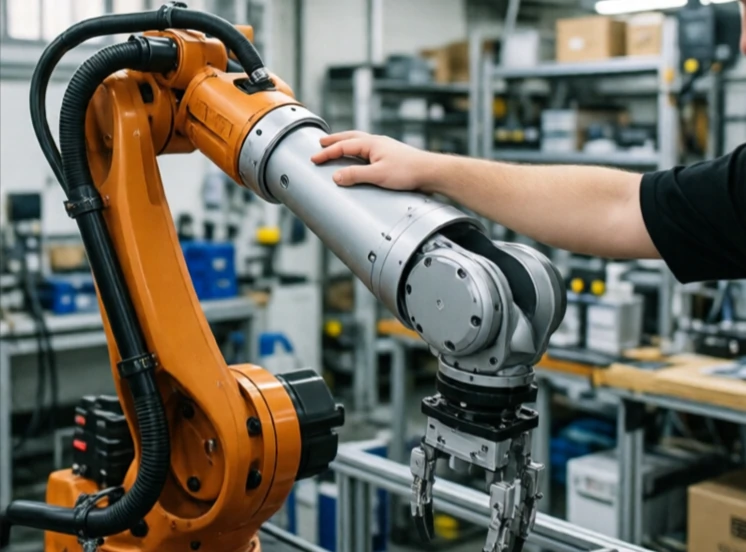
Impedance control regulates the dynamic relationship between force and motion. It makes a robot behave like a mass-spring-damper system. Push it and it moves, but with resistance. Let go and it returns. The impedance determines how stiff or soft that response feels.
Unlike force control, which tries to maintain a specific force, impedance control defines how the robot responds to external forces. A low impedance makes the robot compliant and easy to push. A high impedance makes it stiff and resistant. The controller adjusts impedance based on the task. Inserting a peg might use low impedance to allow alignment. Grinding might use high impedance to maintain pressure.
Impedance control parameters
- Virtual mass: resistance to acceleration.
- Virtual damping: resistance to velocity.
- Virtual stiffness: resistance to displacement.
- Adaptive impedance: changes based on contact.
- Variable impedance: task-dependent tuning.
Impedance control is essential for robots that interact with uncertain environments. A robot arm using position control will fight a moving surface. An impedance-controlled arm will follow it. The same principle applies to legged robots. A compliant leg absorbs impacts and adapts to uneven ground. The trade-off is precision. A compliant robot is harder to position accurately. Engineers tune the impedance for the task, stiff where accuracy matters, soft where safety and adaptability matter. It is one of the most versatile control strategies in robotics.
Comments
No comments yet. Be the first to share a thought.
Leave a comment