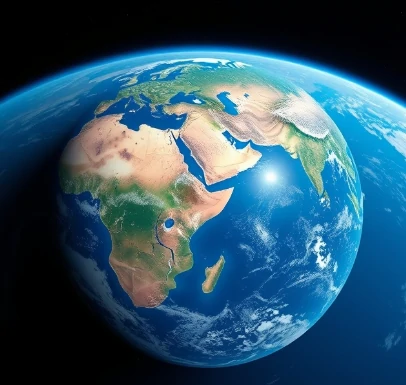
Salt water covers roughly 71 percent of Earth’s surface and contains about 97 percent of the planet’s free water. This continuous body is the global ocean, conventionally divided into the Pacific, Atlantic, Indian, Southern, and Arctic Oceans, though the boundaries are arbitrary.
The ocean regulates climate by storing and transporting heat, absorbs a large fraction of anthropogenic carbon dioxide, and supports the majority of the biosphere’s productivity. Its average depth is nearly 4,000 meters; its volume exceeds 1.3 billion cubic kilometers. Circulation connects every basin, so that water, heat, and dissolved substances are exchanged on timescales from years to millennia.
Human dependence on the ocean for food, transport, recreation, and climate stability is profound, yet the ocean is simultaneously affected by warming, acidification, overfishing, and pollution. Scientific understanding has advanced rapidly with satellites, autonomous floats, and deep-diving vehicles, yet large regions and processes remain undersampled. The ocean is both the dominant feature of the planet and one of its least fully explored.
- Continuous body of salt water covering most of Earth
- Regulates climate and supports most planetary productivity
- Average depth near 4,000 m
- Under increasing human pressure
Comments
No comments yet. Be the first to share a thought.
Leave a comment