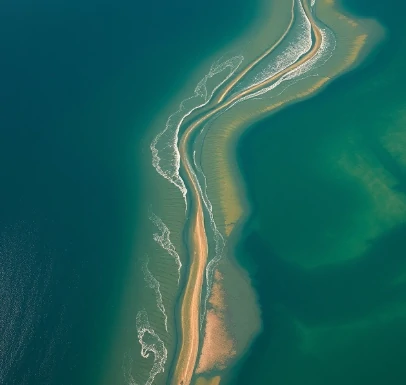
Where rivers meet the sea, fresh and salt water mix in a partially enclosed coastal embayment. These transition zones are estuaries. They are among the most productive ecosystems on Earth, supporting nurseries for fish and shellfish, extensive wetlands, and dense human populations.
The balance between river discharge and tidal mixing determines the salinity gradient and the residual circulation. Some estuaries are vertically well mixed; others maintain a salt wedge that intrudes beneath the outflowing fresh water. Sediments, nutrients, and pollutants delivered by the river are processed, trapped, or exported to the coastal ocean.
Estuaries provide critical ecosystem services including water filtration, carbon burial, and storm buffering. They are also heavily impacted by development, dredging, nutrient enrichment, and sea-level rise. Management requires coordinated attention to both the watershed and the marine end of the system. Each estuary has a unique geometry and forcing, so local knowledge remains essential.
- Coastal mixing zone of river and seawater
- Highly productive nursery habitats
- Process nutrients and sediments
- Vulnerable to human pressures and sea-level rise
Comments
No comments yet. Be the first to share a thought.
Leave a comment