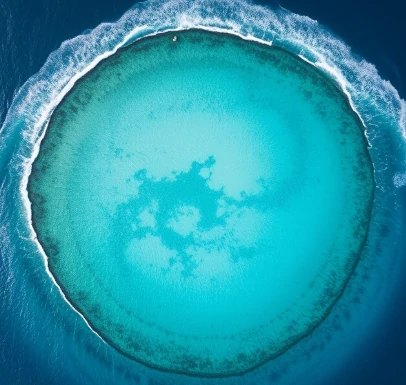
In the clear waters of tropical oceans, coral reefs sometimes form perfect rings enclosing a central lagoon. These structures are atolls. Most began as fringing reefs around volcanic islands; as the volcano slowly subsided, the coral kept building upward, eventually leaving only the reef and lagoon.
The outer reef faces the open ocean and breaks the force of waves. The lagoon inside is usually shallow, calm, and filled with patch reefs and sandy bottoms. Atolls support rich marine life yet are vulnerable to sea-level rise, ocean warming, and storm damage because their elevation is so low.
Classic examples occur in the Pacific and Indian Oceans. Charles Darwin first proposed the subsidence theory of atoll formation during the voyage of the Beagle; modern drilling and dating have largely confirmed it. Today atolls also serve as natural laboratories for studying reef resilience and the limits of coral growth.
- Ring-shaped coral reef enclosing a lagoon
- Forms as volcanic islands subside
- Low elevation and highly vulnerable to sea-level rise
- Supports diverse marine communities
Comments
No comments yet. Be the first to share a thought.
Leave a comment