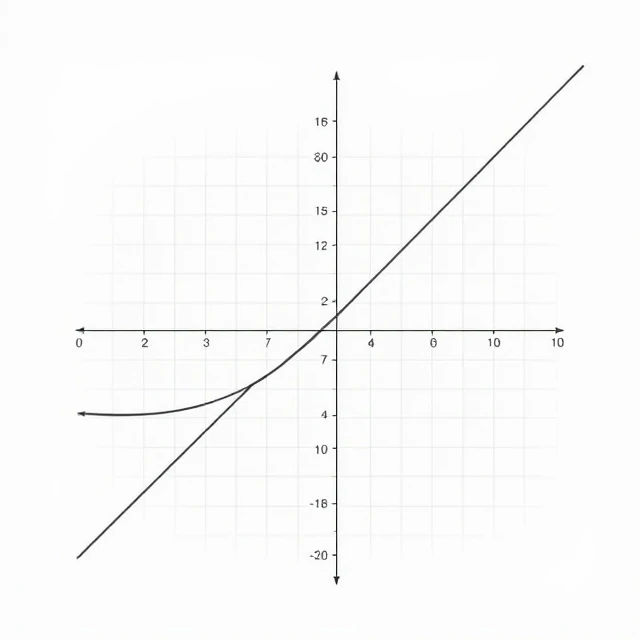
Calculus tackles problems that algebra cannot: how fast something changes, and how much accumulates. It has two main branches. Differential calculus studies rates of change—velocity, slope, growth. Integral calculus studies accumulation—area, volume, total distance.
Newton and Leibniz developed the subject independently in the seventeenth century. Newton used it for physics and astronomy; Leibniz devised the notation we still use, like dy/dx and the integral sign. Their work built on ideas from Archimedes, Descartes, and Fermat.
The fundamental theorem of calculus links the two branches: differentiation and integration are inverse operations. That connection makes it possible to solve a vast range of problems in physics, engineering, economics, and biology. Calculus describes planetary orbits, population growth, electrical circuits, and the spread of diseases. It remains one of the most powerful and widely applied areas of mathematics.
- Studies continuous change and accumulation
- Two branches: differential and integral
- Developed by Newton and Leibniz
- Fundamental theorem links differentiation and integration
Comments
No comments yet. Be the first to share a thought.
Leave a comment