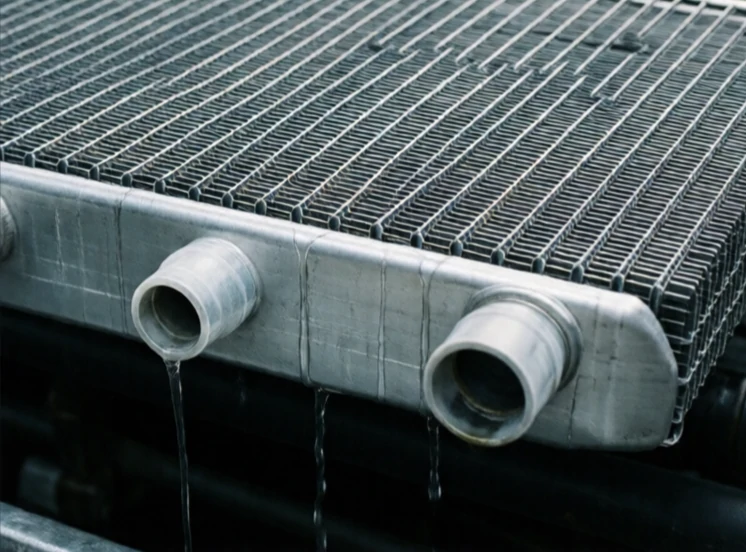
An engine produces enough heat to destroy itself. The radiator keeps that from happening. Hot coolant flows from the engine into thin tubes lined with fins. Air passing through the fins carries heat away. The cooled coolant circulates back to the engine.
Early cars used air cooling or simple thermosiphon systems. Pressurized radiators, introduced in the 1930s, raised the boiling point and allowed smaller units. Today's radiators are aluminum, often with plastic end tanks, and they work with a thermostat, water pump, and cooling fan to hold engine temperature in a narrow band.
Signs of radiator trouble
- Coolant puddles under the front of the car.
- Temperature gauge climbing above normal.
- Sweet smell of antifreeze near the engine bay.
- Discolored or sludgy coolant in the overflow tank.
A radiator is a wear item. Internal passages clog, seams crack, and plastic tanks become brittle. Flushing the cooling system on schedule extends its life. Ignoring a small leak usually turns into an overheated engine and a much larger repair bill.
Comments
No comments yet. Be the first to share a thought.
Leave a comment