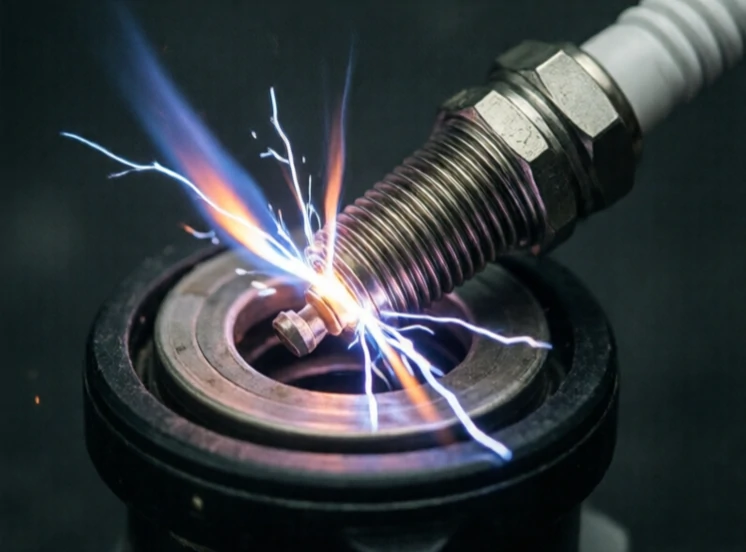
Ignition is the moment a spark or compression wave sets fuel burning inside an engine cylinder. Without it, nothing moves. The term covers both the event and the system that triggers it.
Early cars used magnetos and hand cranks. Charles Kettering's electric self-starter, introduced on the 1912 Cadillac, removed the crank and made driving accessible to more people. Points and condensers ran ignition systems for decades until electronic ignition arrived in the 1970s, followed by distributorless coil-on-plug setups.
Parts of a typical ignition system
- Battery and ignition switch.
- Ignition coil to step voltage up to thousands of volts.
- Spark plug to arc across the gap.
- Control module to time the spark.
- Crankshaft and camshaft sensors to report position.
Timing matters as much as spark. Fire too early and the engine knocks. Too late and power drops while exhaust temperatures climb. Diesel engines skip the spark entirely and rely on compression heat to ignite the fuel. That is why a diesel has no spark plugs at all.
Comments
No comments yet. Be the first to share a thought.
Leave a comment