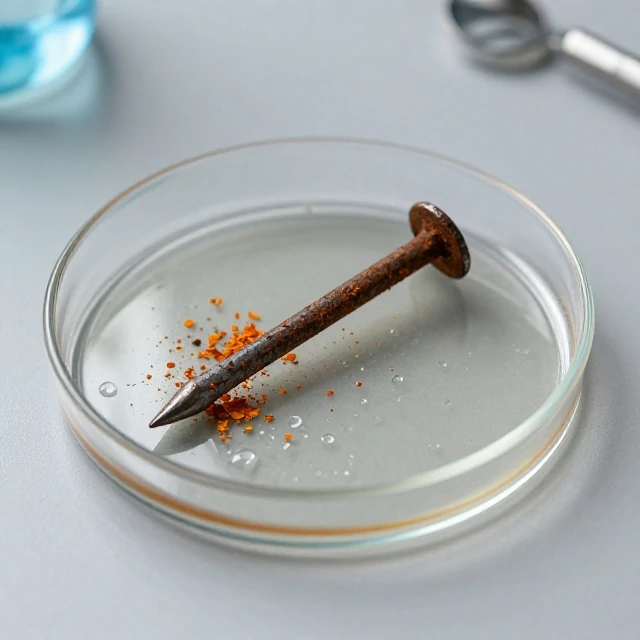
A chemical property describes how a substance behaves in a chemical reaction. Flammability, reactivity, toxicity, acidity, oxidation state: these are chemical properties. They become evident only when the substance changes into something new. You cannot measure flammability by looking at a log. You have to burn it.
Physical properties, by contrast, are observable without changing the substance. Melting point, density, color, and hardness are physical properties. Chemical properties require a reaction. Iron rusts in the presence of oxygen and water. That is a chemical property. Iron is dense and gray. Those are physical properties.
Examples of chemical properties
- Reactivity with water, oxygen, or acids.
- Flammability and combustion temperature.
- Toxicity and biological effects.
- Oxidation states and reduction potential.
- Radioactivity and half-life.
Chemical properties determine how a substance can be used and how it must be handled. Hydrogen is highly flammable. Chlorine is toxic. Gold is unreactive, which is why it stays shiny for centuries. Chemists use chemical properties to predict what will happen when substances mix. Will they react violently? Will they form a useful product? Will they release heat? The answers come from understanding chemical properties. They are not visible on the surface. They are hidden in the electrons and bonds. That is what makes chemistry interesting. The same atoms can behave differently depending on how they are arranged.
Comments
No comments yet. Be the first to share a thought.
Leave a comment