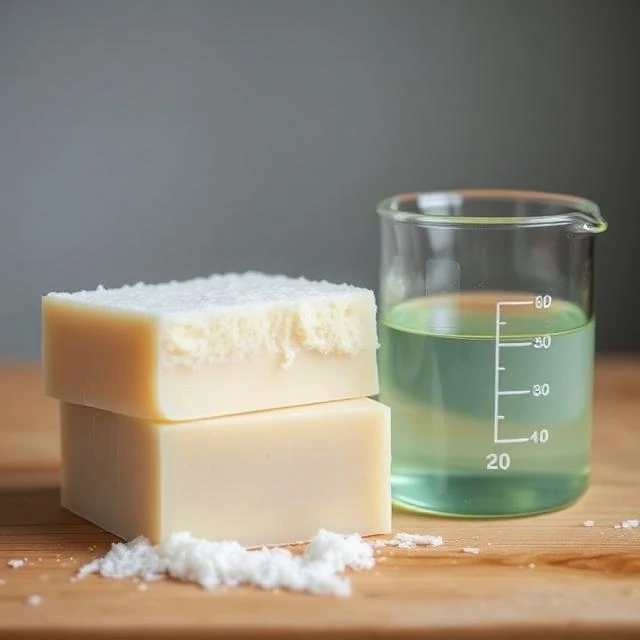
Bases feel slippery. Soap, bleach, and baking soda all share that quality. The word comes from the Latin basis, meaning foundation. Chemists define a base as a substance that accepts protons or donates electron pairs. The Brønsted-Lowry definition focuses on proton acceptance. The Lewis definition focuses on electron pair donation. Both are useful, depending on the context.
In water, a base accepts a proton from water, producing hydroxide ions. The more hydroxide ions in solution, the higher the pH. Sodium hydroxide dissociates completely in water, making it a strong base. Ammonia accepts protons only partially, making it a weak base. Like acids, bases can be strong or weak, concentrated or dilute. The terms are not interchangeable.
Bases react with acids to form salts and water. This neutralization reaction is one of the most fundamental in chemistry. Bases also react with fats and oils to form soap, a process called saponification. They denature proteins, which is why bleach and lye are corrosive. They are used in industrial processes, water treatment, and household cleaning. The human body uses bases to buffer pH and maintain homeostasis.
The pH scale measures acidity and basicity. A pH below 7 is acidic. A pH above 7 is basic. A pH of 7 is neutral. The scale is logarithmic, so each unit represents a tenfold change in hydrogen ion concentration. A pH of 12 is a million times more basic than a pH of 6.
Comments
No comments yet. Be the first to share a thought.
Leave a comment