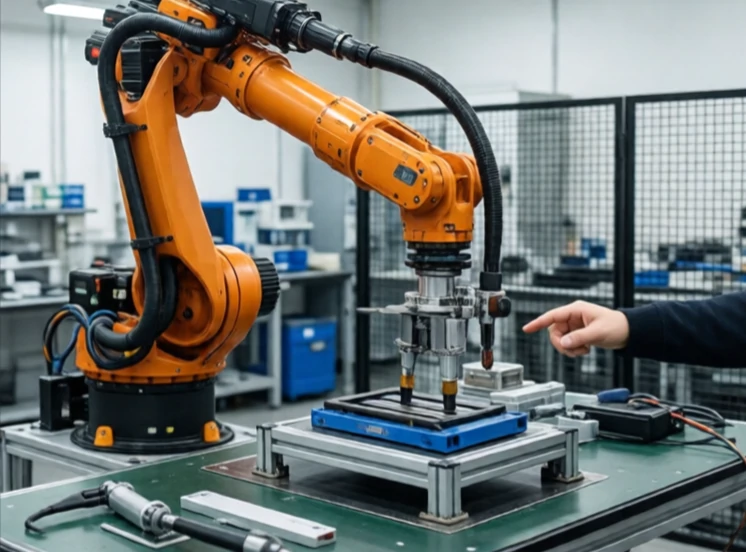
A robotic arm is a mechanical arm with joints that mimic human arm movements. It has a base, segments, and an end effector. The joints rotate or slide to position the end effector in space. Most industrial arms have six joints, giving them the flexibility to reach any point and orientation within their workspace.
The first industrial arm, Unimate, was installed at General Motors in 1961. It had one arm and did one job: lifting hot metal parts. Today, robotic arms weld, paint, assemble, and inspect. They range from tiny arms that assemble watches to massive arms that move car bodies. Collaborative arms work alongside humans without cages.
Robotic arm configurations
- Articulated: rotary joints, human-like, most common.
- SCARA: horizontal arm, fast, assembly.
- Delta: parallel links, high speed, pick-and-place.
- Cartesian: linear axes, simple, CNC tending.
- Collaborative: lightweight, force-limited, safe with humans.
A robotic arm is defined by its reach, payload, speed, and repeatability. Reach determines the workspace. Payload determines what it can lift. Speed determines cycle time. Repeatability determines precision. No single arm excels at all four. A large arm with long reach is slower and less precise. A small arm is fast and precise but cannot lift much. Choosing the right arm means matching the specifications to the task. The arm is the most recognizable part of a robot. It is also one of the most versatile machines ever built. Change the end effector and the same arm can weld, paint, or pick fruit.
Comments
No comments yet. Be the first to share a thought.
Leave a comment