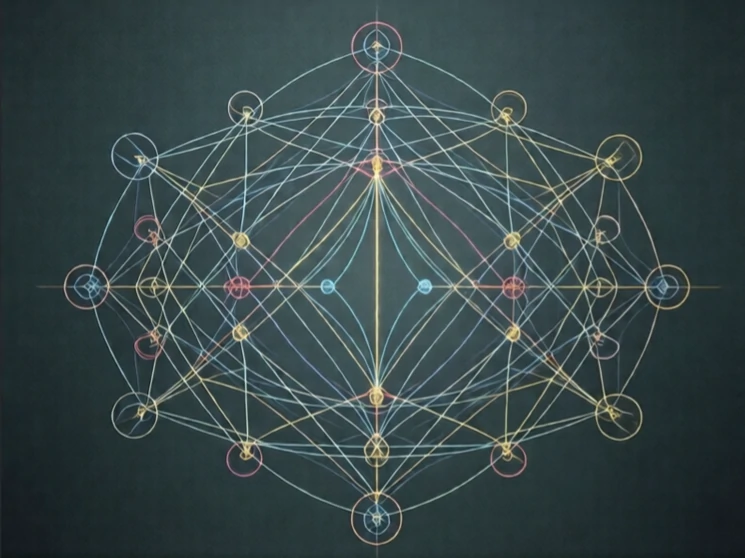
Gestalt is a German word meaning “organized whole.” The Gestalt school of psychology emphasized that the whole of perception is different from the sum of its sensory parts. The mind imposes structure, grouping elements into coherent forms according to principles that operate automatically.
Max Wertheimer, Wolfgang Köhler, and Kurt Koffka challenged the idea that perception is built piece by piece from elementary sensations. They pointed to phenomena such as apparent motion—two stationary lights flashing in sequence are seen as a single light moving—and to the immediate organization of a scene into figure and ground. Principles of grouping include proximity, similarity, continuity, closure, and common fate. These principles describe how the visual system prefers simple, stable, and complete organizations.
Gestalt ideas influenced later work on problem solving, insight, and social perception. Although the physiological mechanisms were not fully specified by the early Gestalt psychologists, modern vision science has confirmed that many of the organizational tendencies they described arise early in cortical processing.
We do not see a collection of edges and patches. We see objects, scenes, and patterns. Gestalt psychology named that achievement.
Comments
No comments yet. Be the first to share a thought.
Leave a comment