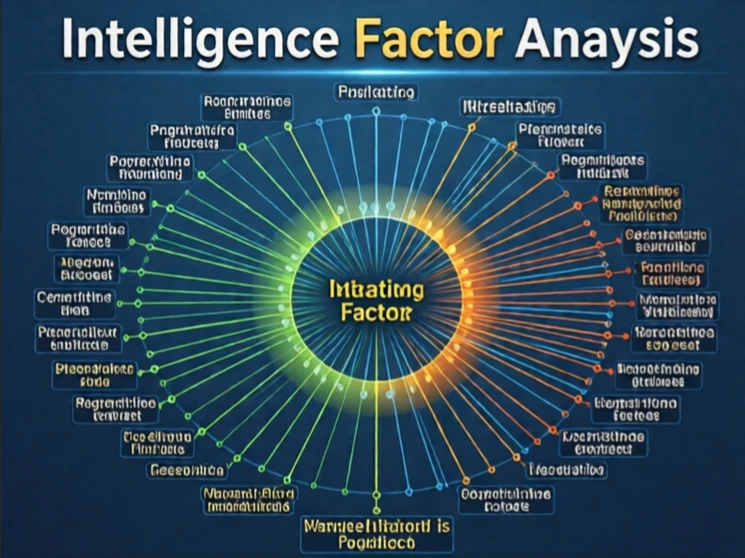
General intelligence, often labeled g, is the common factor that emerges when many different cognitive tests are analyzed together. People who perform well on one type of mental task tend, on average, to perform well on others.
Charles Spearman first identified g through factor analysis of schoolchildren’s scores. He distinguished it from specific abilities that influence performance on particular tests. Subsequent research has repeatedly found a positive manifold—the tendency of cognitive tests to correlate positively with one another—and g accounts for a substantial portion of the shared variance. Tests of abstract reasoning, working memory, and processing speed typically load highly on g.
The biological basis of g remains an active research area. Measures of brain volume, neural efficiency, and the integrity of white-matter tracts show modest correlations with g. Twin and adoption studies indicate substantial heritability, though estimates vary with age and environment. Critics argue that g is a statistical abstraction rather than a single underlying entity, yet its predictive power for educational and occupational outcomes is well established.
Whatever else intelligence may be, the general factor is the part that shows up across almost every demanding mental task.
Comments
No comments yet. Be the first to share a thought.
Leave a comment