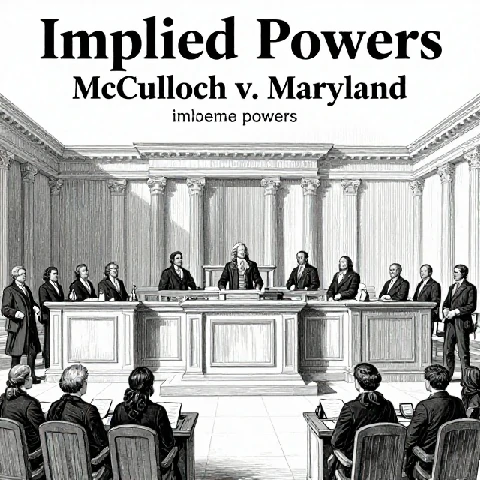
Implied powers are powers not explicitly stated in the Constitution but necessary to carry out enumerated powers. They come from the Necessary and Proper Clause. Congress can do what is necessary and proper to execute its expressed powers. The clause is also called the elastic clause. It stretches federal authority.
The doctrine was established in McCulloch v. Maryland in 1819. The Supreme Court upheld the creation of the Second Bank of the United States. The Constitution did not explicitly authorize a bank. But the bank was a useful instrument for carrying out Congress's powers to tax, borrow, and regulate commerce. Chief Justice Marshall wrote that the power to tax implies the power to destroy. The bank was constitutional. Implied powers were born.
Examples of implied powers
- Creating a national bank.
- Establishing a military draft.
- Regulating the internet and airwaves.
- Building the interstate highway system.
- Creating federal agencies like the EPA and FDA.
Implied powers are controversial. Strict constructionists argue for a narrow reading. They say the federal government should only do what the Constitution explicitly says. Loose constructionists argue for a broad reading. They say the Constitution is a framework, not a rulebook. It must adapt to changing circumstances. The debate is as old as the Republic. It shaped the struggle over slavery, the New Deal, and civil rights. It shapes current debates over healthcare, environmental regulation, and surveillance. Implied powers are the growing edge of federal authority. They expand as new needs arise. That expansion worries some. It reassures others. The elastic clause is the Constitution's flexibility. Without it, the document would be rigid. With it, the document is a living charter. The question is how far it stretches. The answer is never final.
Comments
No comments yet. Be the first to share a thought.
Leave a comment