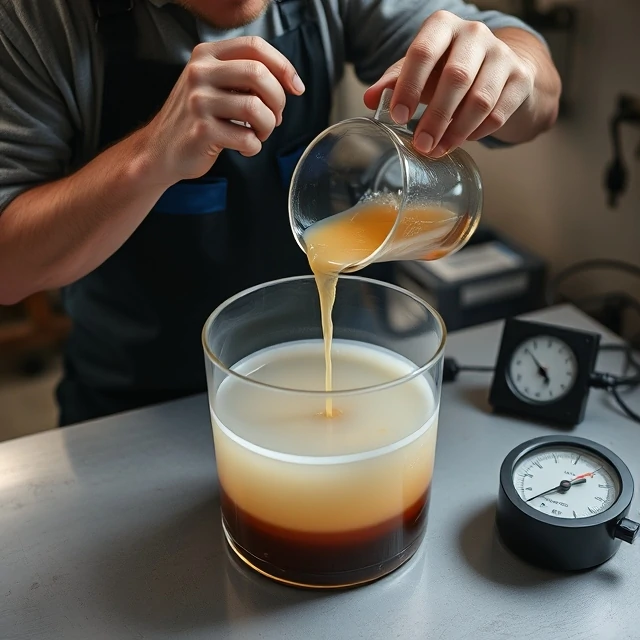
Expose film to light and a latent image forms on the emulsion. It is invisible. Developing makes it visible. The film is treated with a chemical developer that reduces the exposed silver halide crystals to metallic silver. The image emerges, initially faint, then darkening as the process continues. Stop bath halts development. Fixer removes the remaining unexposed silver halides, making the image permanent. Then the film is washed and dried.
Developing is time-sensitive and temperature-sensitive. The developer must be at the right concentration and temperature, and the film must be agitated on a schedule. Push processing extends development time to increase effective ISO, at the cost of increased grain and contrast. Pull processing shortens it. Different developers produce different results. Some are fine-grain and low-contrast. Others are sharp and contrasty. The choice of developer is part of the photographer's toolkit, just like the choice of film. Digital photography has no equivalent to developing, though RAW processing is sometimes called digital development. The analogy is imperfect. In film, the latent image is made visible. In digital, the data is already there, waiting to be interpreted.
Steps in film developing
- Developer. Makes the latent image visible.
- Stop bath. Halts development.
- Fixer. Removes unexposed silver halides.
- Wash. Removes residual chemicals.
- Dry. Prepares the film for printing or scanning.
Developing is chemistry, but it is also craft. Small variations produce different results, and experienced photographers learn to read those variations.
Comments
No comments yet. Be the first to share a thought.
Leave a comment