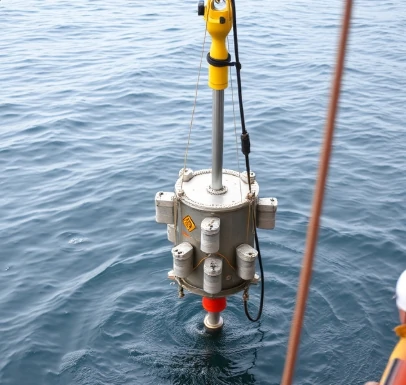
The ability of seawater to conduct electrical current depends primarily on the concentration of dissolved ions. Conductivity therefore serves as a precise and easily measured proxy for salinity. Oceanographers report conductivity in siemens per meter and then convert the value to practical salinity using established equations that also account for temperature and pressure.
Modern CTD instruments record conductivity, temperature, and depth at high frequency as they are lowered through the water column. The resulting profiles reveal water-mass structure, mixing, and the pathways of circulation. Because conductivity sensors respond quickly and stably, they form the backbone of both shipboard and autonomous salinity observations.
Absolute salinity, which accounts for regional differences in seawater composition, is now preferred for precise density calculations, yet conductivity remains the observable from which salinity is derived. Calibration against standard seawater ensures consistency across the global observing system.
A change of only a few hundredths of a salinity unit is readily detected by a well-calibrated conductivity cell.
Comments
No comments yet. Be the first to share a thought.
Leave a comment