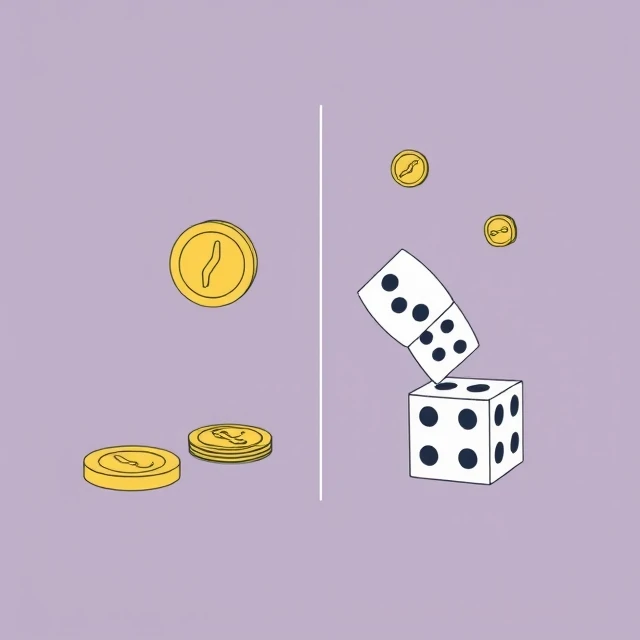
Probability measures how likely an event is. It ranges from 0 (impossible) to 1 (certain). A fair coin has probability 0.5 of landing heads. A die has probability 1/6 of showing a 3. The sum of probabilities of all possible outcomes is 1.
Probability began with games of chance. Pascal and Fermat corresponded about gambling problems in the seventeenth century, laying foundations for the field. Laplace, Kolmogorov, and others formalized it. Kolmogorov's axioms define probability in terms of a sample space and a measure.
Probability theory underpins statistics, finance, physics, and machine learning. It models uncertainty in weather, markets, and quantum mechanics. Conditional probability, independence, and Bayes' theorem are key concepts. The subject is both practical and deeply mathematical.
- Measure of likelihood from 0 to 1
- All outcomes sum to 1
- Formalized by Kolmogorov's axioms
- Used in statistics, finance, and machine learning
Comments
No comments yet. Be the first to share a thought.
Leave a comment