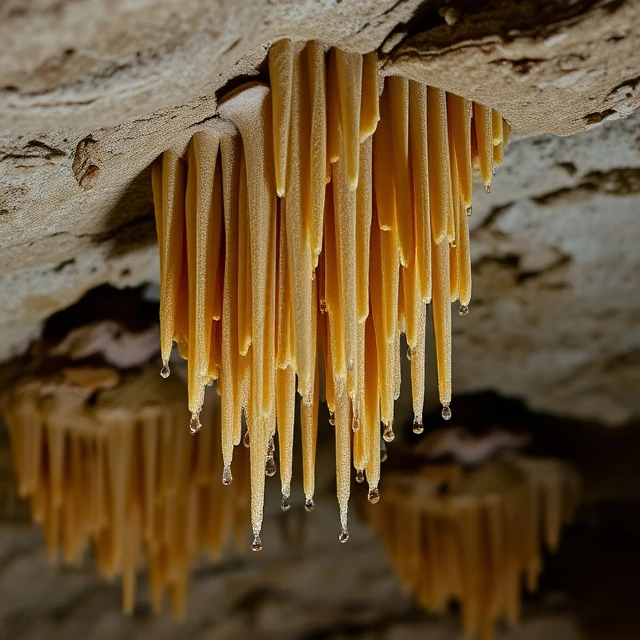
Water dripping from a cave ceiling leaves a thin film of dissolved minerals. Over time the minerals build a downward-growing formation called a stalactite. Most stalactites are composed of calcite precipitated from limestone-rich water.
Each drop deposits a small ring of mineral at the tip. A central canal often remains through which water continues to flow. Growth rates are typically slow—fractions of a millimeter per year—so large stalactites represent thousands of years of accumulation.
Stalactites are among the most familiar speleothems and contribute to the scenic beauty of show caves. Their chemical composition and growth layers also serve as archives of past climate and vegetation. Breaking them destroys both aesthetic and scientific value that cannot be quickly replaced.
- Mineral formation hanging from a cave ceiling
- Grows downward by dripping water
- Usually composed of calcite
- Records long-term environmental conditions
Comments
No comments yet. Be the first to share a thought.
Leave a comment