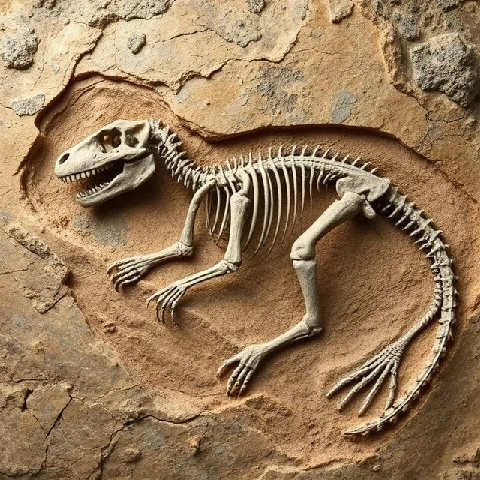
Traces of ancient life are preserved in the rock record. A fossil is any remains, imprint, or evidence of an organism from a past geologic age. Bones, shells, tracks, burrows, and even chemical signatures can all qualify.
Most organisms decay before preservation can occur; fossilization is the exception. Rapid burial, hard parts, and quiet chemical conditions favor preservation. Permineralization, molds, casts, and carbonization are common modes. Soft-tissue preservation is rare but provides exceptional detail when it happens.
Fossils calibrate the geologic time scale, document evolutionary change, and allow reconstruction of past environments and climates. Index fossils that were widespread yet short-lived are especially useful for correlation. Every fossil represents both a once-living organism and a set of processes that allowed its remains to endure.
- Preserved remains or traces of ancient life
- Requires special conditions for preservation
- Used for dating and paleoenvironmental reconstruction
- Includes body fossils and trace fossils
Comments
No comments yet. Be the first to share a thought.
Leave a comment