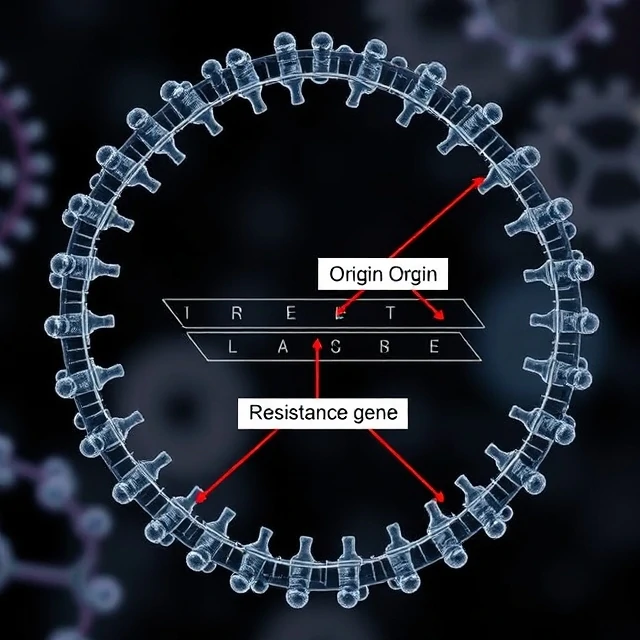
Bacteria often carry extra DNA beyond their chromosome. A plasmid is a small, usually circular DNA molecule that replicates independently. Plasmids frequently harbor genes for antibiotic resistance, metabolic functions, or virulence.
In the laboratory, plasmids are engineered as vectors to clone and express genes. They contain an origin of replication, selectable markers, and multiple cloning sites. Researchers introduce recombinant plasmids into host cells by transformation. The host then produces many copies of the plasmid and any inserted gene.
Natural plasmids move between bacteria by conjugation, spreading traits through populations. Artificial plasmids remain indispensable tools for gene cloning, protein production, and gene therapy vector construction. Their small size and ease of manipulation make them foundational to molecular biology.
- Small circular DNA molecule
- Replicates independently of the chromosome
- Used as cloning and expression vectors
- Often carries antibiotic-resistance genes
Comments
No comments yet. Be the first to share a thought.
Leave a comment