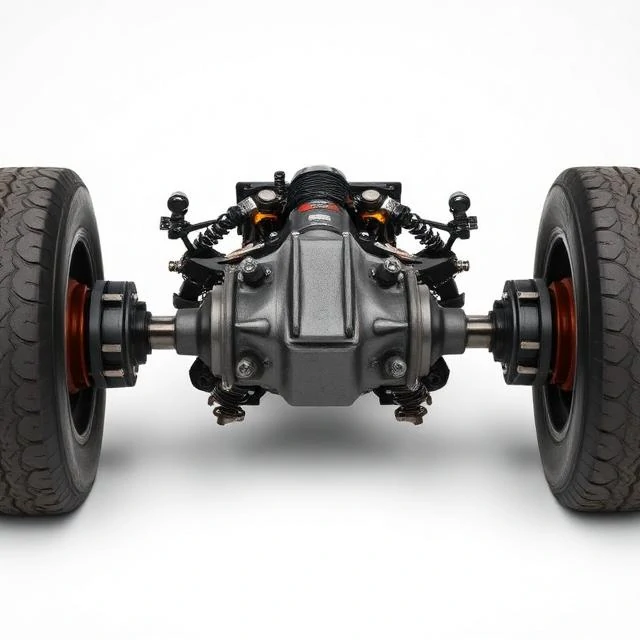
An axle is a central shaft that supports and rotates the wheels of a vehicle. It carries the weight of the car, transmits driving force to the wheels, and keeps the wheels aligned. Some axles are dead, meaning they only support weight and do not drive the wheels. Others are live, meaning they transmit power from the differential to the wheels.
In a rear-wheel-drive car, the rear axle is live. It receives torque from the driveshaft through the differential and sends it to the rear wheels. The front axle is dead, supporting the weight and steering. In a front-wheel-drive car, the roles are reversed, and the rear axle is often a simple beam or independent suspension without drive components.
Axle design affects handling, ride comfort, and load capacity. A solid beam axle is simple and strong, common in trucks and older cars. Independent suspension uses separate axles for each wheel, allowing them to move independently. That improves ride quality and traction, especially on uneven roads. Most modern passenger cars use independent suspension at the front and either independent or beam axles at the rear.
Axles also have a gear ratio, either built into the differential or the axle itself. That ratio determines how engine speed translates to wheel speed and affects acceleration and fuel economy.
Comments (3)
Leave a comment