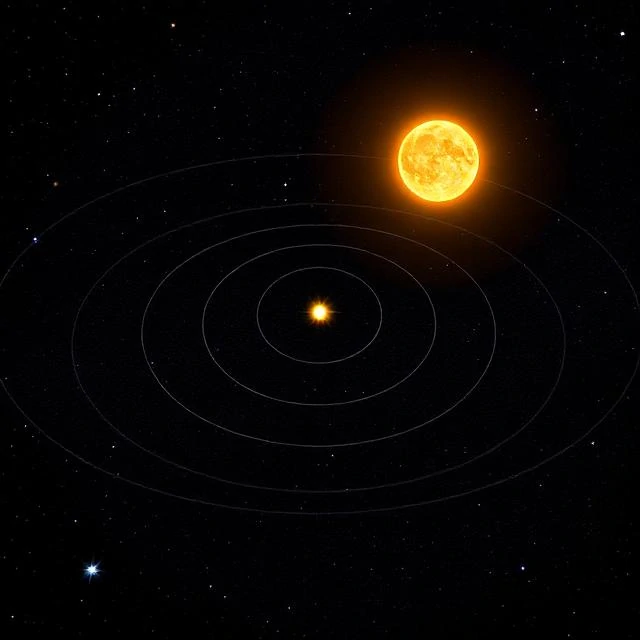
Hold your thumb at arm's length and close one eye, then the other. Your thumb appears to shift against the background. That is parallax. Astronomers use the same effect to measure the distance to nearby stars. As Earth orbits the Sun, our viewpoint shifts by about 300 million kilometers over six months. Nearby stars appear to move slightly against the more distant background.
The amount of shift is tiny. Even for the nearest star, Proxima Centauri, the parallax angle is less than one arcsecond, which is 1/3600 of a degree. Measuring such small angles requires precise instruments and careful calibration. The European Space Agency's Gaia mission has measured parallaxes for nearly two billion stars with unprecedented accuracy.
Parallax is the first rung on the cosmic distance ladder. It provides direct, geometric distances without assumptions about the physics of stars. Everything above it depends on this foundation. If parallax is wrong, the entire ladder is wrong.
The word comes from the Greek parallaxis, meaning change. The same principle is used in surveying, photography, and computer vision. In astronomy, it is the gold standard for distance measurement.
Comments
No comments yet. Be the first to share a thought.
Leave a comment