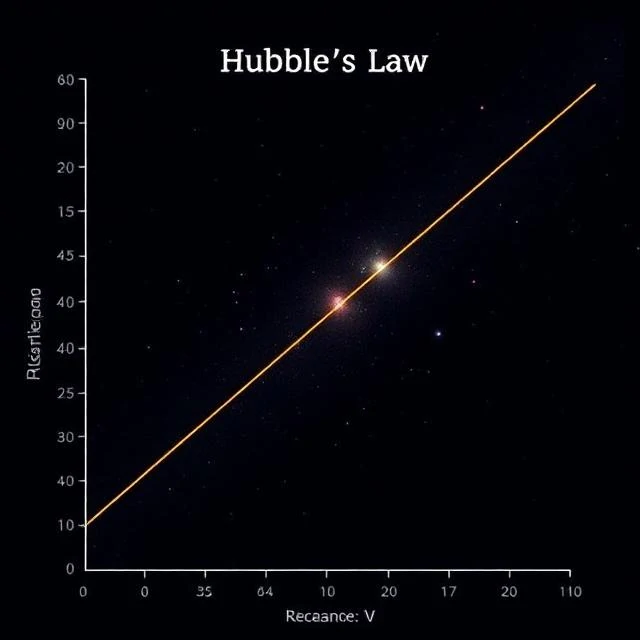
In 1929, Edwin Hubble announced that galaxies are moving away from us, and the farther they are, the faster they recede. The relationship is linear: velocity equals the Hubble constant times distance. The Hubble constant, usually written as H0, is the rate at which the universe is expanding per unit distance.
Measuring H0 has been a challenge for nearly a century. Different methods give different answers. The cosmic microwave background, combined with the standard model of cosmology, gives a value of about 67 kilometers per second per megaparsec. Measurements from Cepheids and Type Ia supernovae give about 73. The discrepancy is called the Hubble tension, and it may be a sign of new physics.
The units are awkward. A megaparsec is 3.26 million light-years. A Hubble constant of 70 means that a galaxy 1 megaparsec away recedes at 70 kilometers per second. A galaxy 2 megaparsecs away recedes at 140. The expansion is not a velocity through space. It is the stretching of space itself.
Resolving the tension is one of the biggest goals in cosmology. New telescopes and new methods are attacking the problem from both ends.
Comments
No comments yet. Be the first to share a thought.
Leave a comment