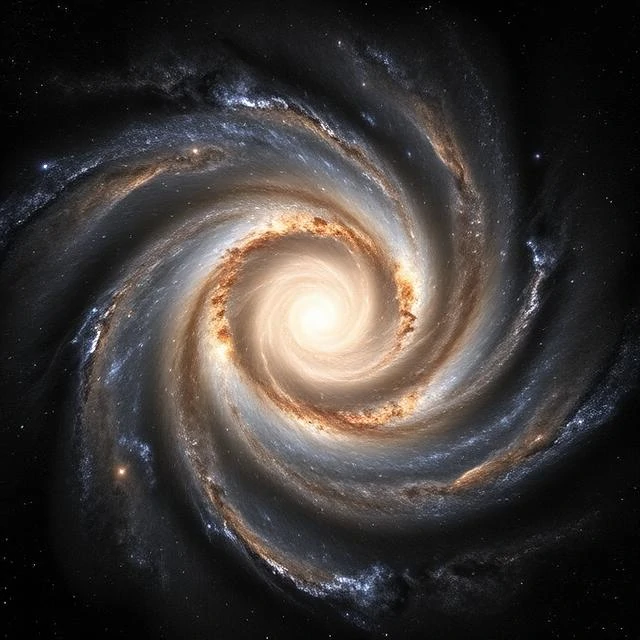
A galaxy is a gravitationally bound system of stars, gas, dust, and dark matter. The Milky Way is our galaxy. It contains a few hundred billion stars, including the Sun, and it is about 100,000 light-years across. It is one of hundreds of billions of galaxies in the observable universe.
Galaxies come in different shapes. Spiral galaxies have rotating disks, spiral arms, and central bulges. Elliptical galaxies are smooth and featureless, with older stars and little gas. Irregular galaxies have no clear shape and are often small. The Hubble classification scheme, developed by Edwin Hubble in 1926, organizes them into these categories.
Galaxies form and evolve through mergers and accretion. The Milky Way is on a collision course with the Andromeda Galaxy. They will merge in about 4.5 billion years, forming a larger elliptical galaxy. The event will not destroy the solar system, but it will rearrange the night sky.
At the center of most galaxies lies a supermassive black hole. The Milky Way's is called Sagittarius A*. It has the mass of about 4 million Suns. In 2022, the Event Horizon Telescope captured its image.
Comments
No comments yet. Be the first to share a thought.
Leave a comment