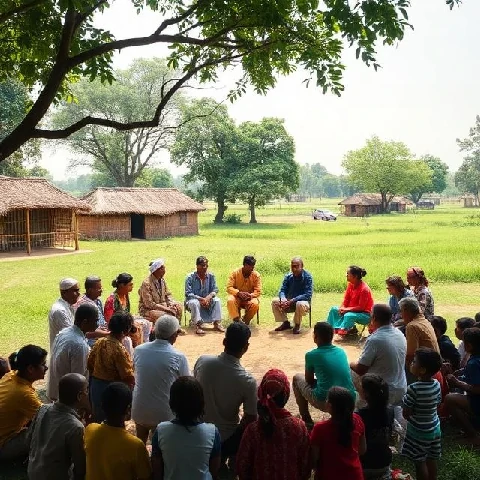
A society is an organized group of people living together under shared institutions and norms. It is broader than a community and more structured than a crowd. Societies have ways of regulating marriage, property, conflict, and the distribution of resources. They also have ways of teaching newcomers what is expected. These rules are not always written down. Much of social life runs on custom, habit, and mutual expectation.
Societies vary enormously in size and complexity. A band of thirty foragers is a society. So is a nation-state of a billion people. What they share is a degree of self-sufficiency and a set of institutions that outlast any individual. Anthropologists have debated whether the concept is still useful. Some argue it implies too much coherence, as if everyone in a society shares the same values. Others defend it as a convenient label for a bounded group.
Key elements
- Shared norms and institutions.
- Mechanisms for social reproduction.
- Some degree of territorial or social boundary.
- Internal differentiation by age, gender, or status.
Societies are not static. They change through internal conflict, external contact, and the choices of ordinary people.
Comments
No comments yet. Be the first to share a thought.
Leave a comment