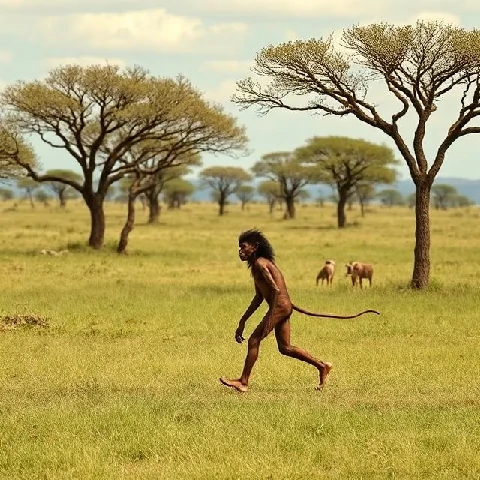
In 1974, a team in Ethiopia unearthed a skeleton that would become one of the most famous fossils in the world. Known as Lucy, she belonged to Australopithecus afarensis, a species that lived in Africa over three million years ago. Australopithecus is an early hominin genus, and its members walked upright on two legs while still retaining many ape-like features.
These creatures were small. Most stood between three and five feet tall, with long arms, curved fingers suited to climbing, and brains not much larger than a chimpanzee's. Yet their pelvis and leg bones show clear adaptations for bipedalism. They lived in a mix of woodland and open savanna, likely spending time in trees and on the ground. Several species are recognized, including afarensis, africanus, and sediba, spanning roughly four to two million years ago.
Why they matter
- They provide the earliest clear evidence of upright walking.
- Stone tools appear later, but their hands could grasp and manipulate.
- Fossil sites cluster in East and South Africa.
- They sit near the branching point of our own genus, Homo.
Australopithecus was not a primitive human. It was a successful, long-lived lineage in its own right.
Comments
No comments yet. Be the first to share a thought.
Leave a comment