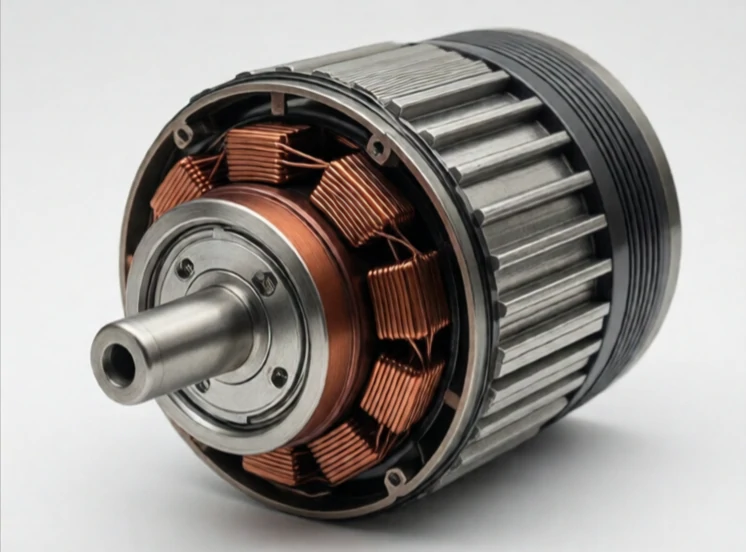
A servo motor is a motor with feedback control for precise positioning. It combines a motor, an encoder, and a controller. The controller compares the commanded position to the actual position and adjusts the motor until they match. Servo motors are the standard actuator for robot joints, CNC machines, and industrial automation.
The term servo comes from the Latin servus, meaning slave. A servo motor slaves its output to a command signal. It does not just spin. It goes to a specific angle and holds it. If a load tries to push it off position, the controller increases current to resist. That makes servo motors ideal for tasks that require force and precision.
Servo motor characteristics
- Closed-loop control: encoder feedback.
- High torque at low speed.
- Fast acceleration and deceleration.
- Accurate positioning.
- Higher cost than stepper or induction motors.
Servo motors come in many sizes. A tiny servo moves a robot finger. A large servo drives a CNC axis or a robot arm joint. AC servo motors dominate industrial applications because they are brushless, efficient, and durable. DC servo motors are used in smaller systems. The controller, often called a servo drive, runs a PID loop and communicates with the main robot controller. Tuning the servo loop is critical. Too much gain and the motor oscillates. Too little and it responds slowly. A well-tuned servo is quiet, precise, and reliable. It is the muscle and the sense of position rolled into one package.
Comments
No comments yet. Be the first to share a thought.
Leave a comment