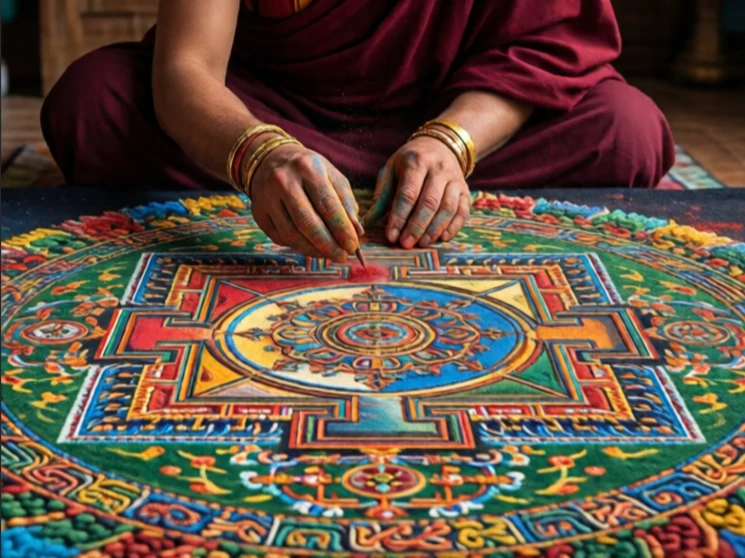
Tantra is a family of ritual and meditative systems that developed within Hinduism and Buddhism from roughly the middle of the first millennium CE. The word itself can mean “loom” or “framework,” suggesting an interwoven set of practices and texts.
Characteristic features include the use of mantras, complex visualizations of deities, ritual diagrams known as mandalas or yantras, and in some streams the deliberate use of substances or acts ordinarily regarded as impure. The goal is rapid transformation—realization of the identity of the practitioner with the divine, or the attainment of both spiritual liberation and worldly powers. Hindu tantra often centers on the worship of Shiva and Shakti; Buddhist tantra, especially in its Tibetan forms, integrates deity yoga within a Mahayana philosophical framework.
Popular imagination has sometimes reduced tantra to sexual technique. While certain antinomian texts do employ sexual symbolism and, more rarely, sexual ritual, the majority of tantric practice is concerned with visualization, mantra, and internal yogic processes. Transmission is typically from teacher to carefully prepared student; secrecy and initiation remain important in many lineages.
Tantra treats the body and the senses not as obstacles to be rejected but as the very means of awakening when properly understood and directed.
Comments
No comments yet. Be the first to share a thought.
Leave a comment