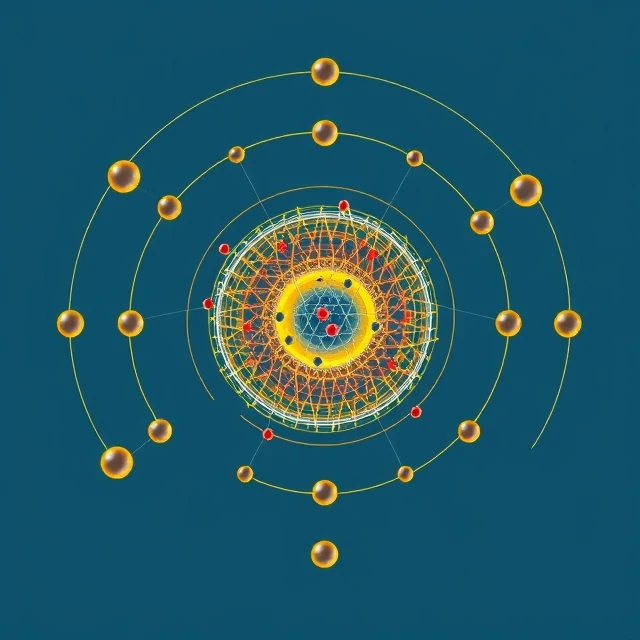
The nucleus is the central core of an atom. It contains protons and neutrons, which are collectively called nucleons. The nucleus carries almost all the mass of the atom but occupies only a tiny fraction of its volume. If an atom were the size of a football stadium, the nucleus would be a pea at the center. The nucleus is held together by the strong nuclear force, which overcomes the electric repulsion between protons. Without it, the nucleus would fly apart.
The number of protons in the nucleus determines the element. Hydrogen has one proton. Helium has two. Carbon has six. Uranium has ninety-two. The number of neutrons can vary, producing isotopes. Carbon-12 has six neutrons. Carbon-14 has eight. Some isotopes are stable. Others are radioactive, decaying over time. The nucleus was discovered by Ernest Rutherford in 1911, through experiments with alpha particles. He found that most alpha particles passed through a thin gold foil, but some bounced back. That meant the atom was mostly empty space, with a dense, positively charged core.
Nucleus facts
- Composition. Protons and neutrons.
- Mass. Almost all the atom's mass.
- Size. Tiny compared to the atom.
- Force. Held together by the strong nuclear force.
- Discovery. Ernest Rutherford, 1911.
The nucleus is not the same as the atom. The atom includes the nucleus and the electrons around it.
Comments
No comments yet. Be the first to share a thought.
Leave a comment