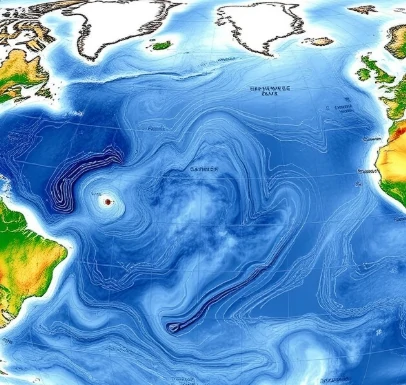
The upper few hundred meters of the ocean are dominated by currents driven primarily by wind. These surface currents organize into the great gyres of the subtropical and subpolar oceans and include swift western boundary currents such as the Gulf Stream and Kuroshio.
Energy is transferred from the wind to the water through frictional drag. The Coriolis effect turns the flow, producing the Ekman spiral and, at larger scales, the geostrophic currents that balance pressure gradients. Surface currents transport heat poleward, influence weather patterns, and disperse larvae, pollutants, and floating debris.
They are observed with satellite altimetry, surface drifters, high-frequency radar, and shipboard measurements. Because they interact directly with the atmosphere, surface currents are tightly coupled to climate variability on seasonal to decadal timescales. Changes in wind patterns can shift current paths and strengths, with consequences for regional climate and marine ecosystems.
- Wind-driven flow in the upper ocean
- Organized into gyres and boundary currents
- Transports heat and materials
- Observed by satellites and drifters
Comments
No comments yet. Be the first to share a thought.
Leave a comment