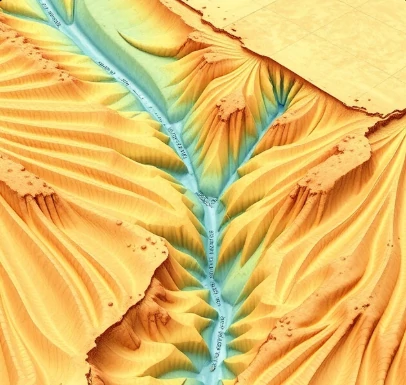
At the outer edge of the continental shelf the seafloor steepens abruptly and descends toward the deep ocean. This continental slope drops from roughly 200 meters to several thousand meters over a relatively short horizontal distance. Gradients of several degrees are common; in places the slope is dissected by submarine canyons.
Sediment that reaches the shelf break can become unstable and cascade down the slope in turbidity currents, carving canyons and depositing fans on the continental rise below. The slope itself is a transition zone between the productive, light-influenced shelf and the dark, food-poor abyss. Biological communities change rapidly with depth along this gradient.
The slope is also a frontier for resource exploration and a pathway for the transport of carbon and pollutants from coastal waters into the deep ocean. Mapping and sampling the slope remain challenging because of the steep terrain and depth. Submarine landslides on continental slopes can generate local tsunamis, adding a geohazard dimension to their study.
Many of the world’s largest submarine canyons cut through the continental slope and rival terrestrial canyons in scale.
Comments
No comments yet. Be the first to share a thought.
Leave a comment