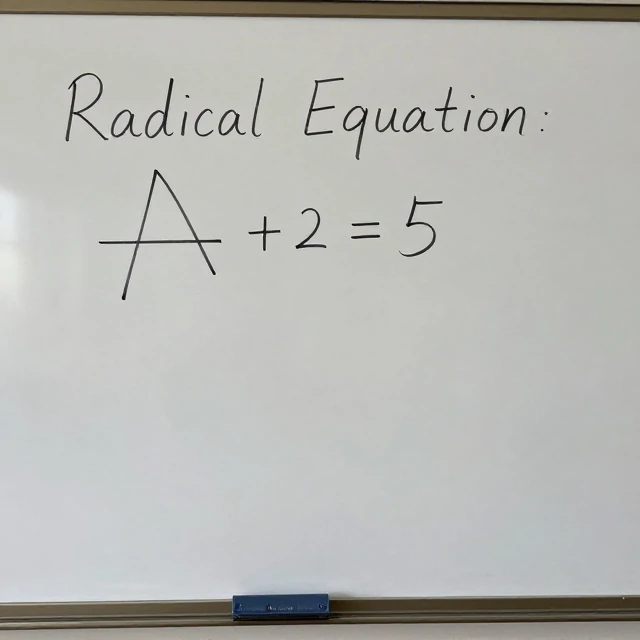
A radical equation has a variable under a radical symbol. The most common radical is the square root. An equation like square root of x plus 2 equals 5 is a radical equation. The variable is inside the radical. To solve it, you isolate the radical and square both sides.
Squaring both sides can introduce extraneous solutions. These are solutions that work in the squared equation but not in the original. Always check your answers. Square root of x plus 2 equals 5. Subtract 2 from both sides: square root of x equals 3. Square both sides: x equals 9. Check: square root of 9 plus 2 equals 3 plus 2 equals 5. Works. But if the equation were square root of x plus 2 equals negative 3, squaring would give x equals 7, which does not work. The square root is never negative. No solution.
Solving radical equations
- Isolate the radical on one side.
- Square both sides.
- Solve the resulting equation.
- Check for extraneous solutions.
- Repeat if there are multiple radicals.
Radical equations appear in physics, engineering, and finance. The period of a pendulum is proportional to the square root of its length. The speed of a wave is the square root of tension divided by linear density. The time to fall a distance is the square root of twice the distance divided by gravity. Solving for the variable often requires squaring. The process is mechanical, but the check is essential. Extraneous solutions are common. They come from the squaring step, which can turn a false statement into a true one. Always substitute your answer back into the original equation. If it does not work, discard it. The math does not lie. The check reveals the truth.
Comments
No comments yet. Be the first to share a thought.
Leave a comment