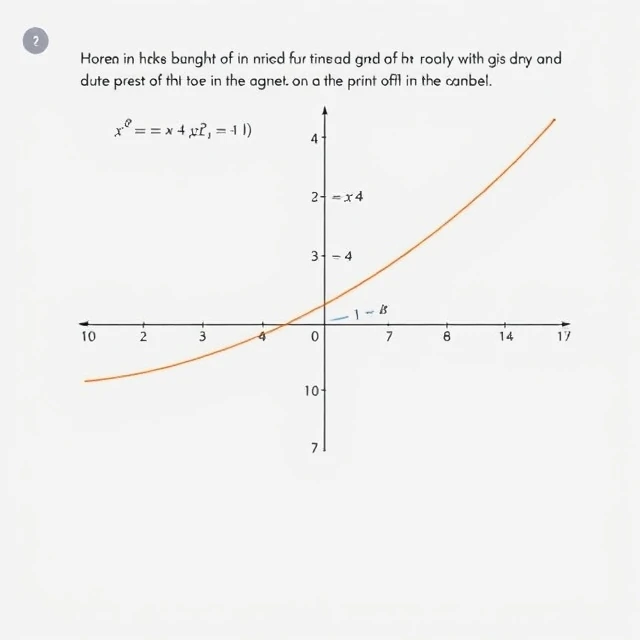
A quadratic equation has the form ax² + bx + c = 0, where a is not zero. The graph is a parabola. Solutions can be found by factoring, completing the square, or using the quadratic formula: x = (−b ± √(b² − 4ac)) / 2a.
The discriminant, b² − 4ac, determines the nature of the roots. If positive, two real roots. If zero, one repeated root. If negative, two complex roots. This classification is a standard part of algebra.
Quadratics model projectile motion, area problems, and optimization. They appear in physics, engineering, and economics. The quadratic formula is one of the most recognized in mathematics. Completing the square, used to derive it, also helps rewrite equations in vertex form.
- Form: ax² + bx + c = 0
- Graph is a parabola
- Quadratic formula gives solutions
- Discriminant determines root types
Comments (2)
Leave a comment