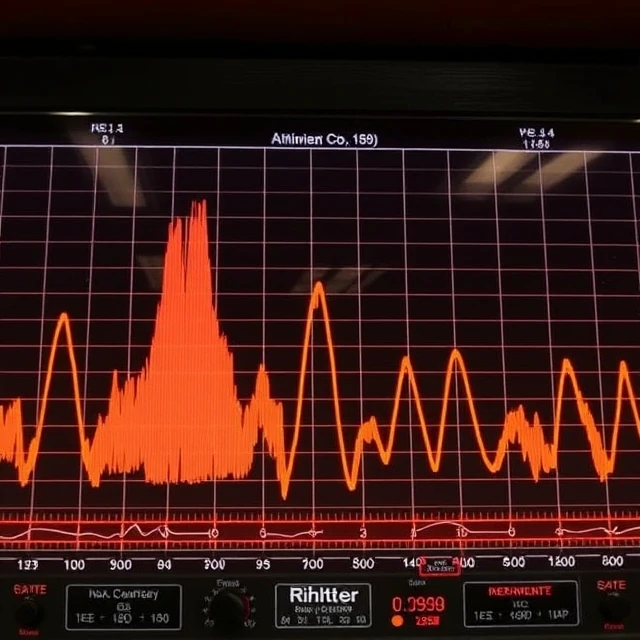
Earthquake size needed a practical numerical measure. The Richter scale, developed in the 1930s, assigns a magnitude based on the logarithm of the amplitude of seismic waves recorded on a standardized seismograph. Each whole-number step corresponds to a tenfold increase in wave amplitude and roughly 32 times more energy.
Originally designed for local earthquakes in California, the scale has been largely superseded by the moment magnitude scale for global use, especially for very large events. Nevertheless, the term “Richter scale” remains widely used in public communication. Magnitudes are determined from instrumental records rather than from observed damage.
A magnitude 5 earthquake is moderate; magnitude 7 is major; magnitude 9 is rare and catastrophic. Because the scale is logarithmic, the difference between successive whole numbers is enormous. Accurate magnitude determination remains a core task of seismological observatories worldwide.
- Logarithmic scale of earthquake magnitude
- Based on seismic-wave amplitude
- Each step is tenfold in amplitude
- Largely replaced by moment magnitude for large events
Comments
No comments yet. Be the first to share a thought.
Leave a comment