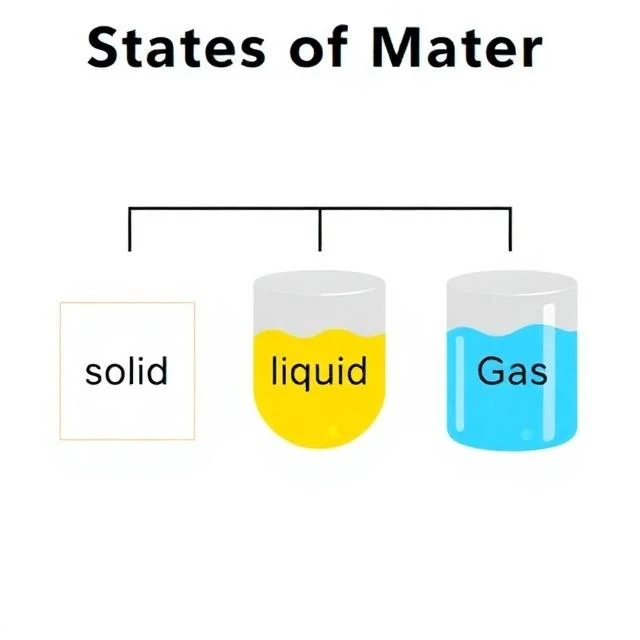
Everything you can touch, taste, or smell is matter. Air is matter. Water is matter. Your phone is matter. Matter is anything that has mass and occupies space. It is made of atoms and molecules. It exists in several states: solid, liquid, gas, and plasma. The state depends on temperature and pressure.
Matter has properties. Physical properties, like density, melting point, and color, can be observed without changing the substance. Chemical properties, like reactivity and flammability, describe how the substance behaves in reactions. Intensive properties do not depend on the amount of matter, like temperature. Extensive properties do, like mass and volume. These distinctions matter in chemistry.
Matter is conserved. In a chemical reaction, the total mass of the reactants equals the total mass of the products. Atoms are rearranged, not created or destroyed. That is the law of conservation of mass, established by Antoine Lavoisier in the 18th century. It is a cornerstone of chemistry.
Matter is not always what it seems. At the atomic scale, it is mostly empty space. The solidity of a table is an illusion created by electromagnetic forces between atoms. Matter is energy in a stable form, as Einstein's equation E = mc^2 shows. A small amount of mass can be converted into a large amount of energy. That is the power of the atom.
Comments
No comments yet. Be the first to share a thought.
Leave a comment